Sunday, July 1, 2012

The Paloma

It's almost the Fourth of July, and the weather has gotten hot.  Very hot.  So when 5:00 o'clock rolled around yesterday, we tried a new drink, The Paloma, which Michael Ruhlman wrote about in his Friday cocktail column. We think the Paloma is delicious, refreshing, and beautiful - the perfect summer cocktail.


The Paloma
Adapted from Michael Ruhlman 
For 1 drink

Make and serve this drink quickly to preserve the effervescence of the grapefruit soda.

2 shots Hornitos Reposada Tequila
2 shots Grapefruit Soda
Juice of half a lime
Spent lime rind

Squeeze the lime half thoroughly to get all its juice.  Put it in a large wine glass.  Add the Tequila and the grapefruit soda.  Stir.  Drop in the lime rind.  Add ice.  Stir again. Serve right away.

Thursday, April 5, 2012

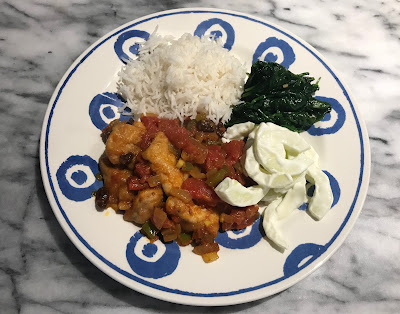
Chicken Country Captain

Adapted from The Joy of Cooking (1964)

Serves 6

When I got engaged at nineteen, a college friend gave me the 1964 edition of The Joy of Cooking—my first cookbook. It was one of the first recipes I made from it, and I have been making it ever since.

In that edition, the book says:

This dish has become a favorite in America, although it probably got its name not from the sea captain who brought the recipe back to our shores, but from the Indian officer who first made him acquainted with it. So says Cecily Brownstone, a great friend; and this is her time-tested formula.

This is very much my version of it.

2 whole boneless chicken breasts
½ cup flour (I use Bob’s Red Mill white rice flour—not sweet), seasoned with salt, pepper, and sweet paprika
1 onion, about the size of a small teacup, diced
1 large green pepper, cut slightly larger than dice
2 stalks celery, sliced thinly on the diagonal
2 cloves garlic, minced
1 tablespoon curry powder
2 cups tomato sauce (tomato passata or 1 (400 g) can San Marzano tomatoes, put through a food mill)
½ teaspoon dried thyme
¼ cup butter or neutral oil
3 tablespoons currants or raisins
Blue Diamond roasted, salted almonds, coarsely chopped, for garnish

Preheat the oven to 350°F.

Cut the chicken into bite-size pieces using kitchen shears. Coat the pieces in the seasoned flour and set aside.

In a sauté pan, brown the chicken pieces in the butter (especially delicious) or a neutral oil. As they brown, remove them and set aside.

Add the onion to the pan and cook until it wilts and just begins to turn pale gold. Add the green pepper and cook for about 2 minutes. Add the celery and cook for another minute. Add the garlic and cook for about 30 seconds. Stir in the curry powder and cook for about 1 minute to bloom the flavor.

Add the tomato sauce and thyme, stirring to deglaze the pan. Bring just to a boil, then reduce the heat. Add salt carefully (remember the chicken was coated in seasoned flour).

If your sauté pan is large enough to hold everything and is oven-safe with a lid, return the chicken to the pan and cover. Otherwise, transfer everything to a covered casserole or Dutch oven.

Bake for about 30 minutes. Add the currants or raisins during the last 5 minutes of cooking.

Just before serving, sprinkle the chopped almonds over the top.

I serve this with basmati rice, mango chutney, and pappadams (when I can get my hands on them), which I cook in hot oil until they puff up.


A Favorite Cury Powder


Pappadams
Pappadams

Wednesday, March 28, 2012

City Ham

Adapted from John Martin Taylor’s “City Ham,” published on Hoppin’ John’s®, John Martin Taylor’s Personal Blog, December 2007; the recipe was originally published in Fine Cooking 38, May 2000 (The Taunton Press).

John Martin Taylor says this ham is so good that “during parties I have to make sure no one’s around when I carve it because folks will flat-out pull the thing to death.”

He’s right.

It’s nice to have a baked ham on hand when you have company coming and going, especially around holidays. It’s perfect sliced thin and tucked into Tiny Corn Muffins, or served with scrambled, poached, or fried eggs. With leftovers, in addition to the obvious sandwiches, you can serve thick slices alongside macaroni and cheese and buttered peas, or sizzle them in a skillet with a little butter for breakfast.

John Martin Taylor, originally from Charleston, calls this a “city ham” — wet-cured — to distinguish it from a “country ham” — dry-cured. Both are delicious, but country ham is best eaten like prosciutto: sliced paper thin and savored sparingly.

The caveat here is that you need the right kind of ham: fully cooked, smoked, preferably not spiral-sliced or glazed, and definitely not canned.

1 whole bone-in fully cooked smoked ham, or
½ bone-in fully cooked smoked ham, shank end preferred but butt end is fine

Preheat the oven to 275°F.

Remove the ham from its packaging. Place it on a flat rack in a roasting pan, and loosely crumple a piece of aluminum foil over the top. You want a soft tent, not a tight seal.

Bake at 275°F for 7 to 8 hours for a whole ham, or 3 to 4 hours for a half ham.

Let the ham rest before carving. Serve warm or at room temperature.


Wednesday, March 14, 2012

Tartar Sauce

Adapted from Lobster Rolls and Blueberry Pie by Rebecca Charles (Artisan, 2003)
Serves about 2 to 4 (easily scaled)

These amounts are loose and depend on how much you want to make. Increase or decrease as needed.

1/3 cup mayonnaise—your favorite (Mine is Ojai.)
1/2 large shallot, minced, or 2 tablespoons minced sweet onion, or some chopped scallions
1 to 2 tablespoons chopped cornichons (I use Maille cornichons)
1 teaspoon cornichon juice
2 teaspoons tiny capers in vinegar, drained
Salt (if necessary) and pepper to taste
A small squeeze of fresh lemon juice

Mix all ingredients together and chill until ready to use.

Rebecca Charles’s Lobster Rolls and Blueberry Pie is more of an interesting memoir than a recipe collection, but there are some good ones included here and there.

Her restaurant, Pearl Oyster Bar, was a favorite when I lived in New York City. If I’d been in the middle of cooking dinner and someone called to say, “Let’s go to Pearl,” I would have turned off the stove and headed for the subway.

She was justifiably famous for her lobster rolls, but I always ordered the Salt-Crusted Shrimp. Every time. Dessert was a different story. I had to choose between the Butterscotch Parfait and the Chocolate Mousse—and it was a difficult decision. I always hoped my dining companion would order one so I could order the other and have a taste of both.

Unfortunately, the recipe for that mousse is not in the book.

But when I found Aileen’s Chocolate Mousse, I was rewarded with a dessert so similar that my craving can be satisfied any time I like.


Sunday, September 11, 2011

Ten Years Later

Posted on the anniversary of 9/11, this is a letter I wrote to a friend just weeks after the attacks, reflecting on life in New York City at the time. It remains unchanged except for this opening paragraph, added when I rediscovered it years later.


I could not bring myself to watch the September 11th memorial services downtown, just three blocks from where I work. And I never want to reward the terrorists and re-live September 11th all over again each year. But this is the Tenth Anniversary, and it is impossible to remain passive today.


When we moved to our new office from West Chelsea at the end of October last year, I came across a file. In it was a copy of The New Yorker published on Septemer 24, 2001, with a copy of an email I sent to a friend in California in response to his question how was I doing and what was New York like. I decided I would post it on this sad anniversary in a world that remains forever changed.

October 10, 2001, 3:33 a.m.

Hey, Friend,

Here we are, already four weeks later. I guess I have so much to say; it's hard to distill it all.

I had a lot of trouble sleeping the first two weeks, and I am still having bad dreams that wake me up. All of us here talk about it, talk about it, talk about it. Of course, the first day we were in the daze of horror. Then we were propelled by the adrenaline that gets you through the shock. We were all stopping each other in the street, "Are you okay?" which had a new and twisted meaning, being stunned all over again when you got the wrong answer, "I took my nephew's dental records to the family center because my sister just couldn't do it." "We're okay, but my girls lost five friends. You know, all these thirty year olds." Can you imagine, friend, all these young people your son's age? Then the good answers. "No, we're okay, and so are our friends. We all work in midtown." That was always good news - "We work in midtown. Our friends work in midtown. Our kids work in midtown." By the third week the total surprise was gone. Now the chilling realization has hit that "life as we know it is over" is not a sound byte. It's the real deal. The Holland Tunnel is still closed. Trucks and vans in and out of the City are stopped for inspection. And instead of its being a pain, it's a comfort. Yes, okay. We'll wait. Check it out. The National Guard is at the airport and on some street corners. Police are everywhere, and people stop at the firehouses, which are surrounded by bouquets of flowers and thank-you notes, to say hello and shake hands and drop off homemade cookies and have their little children meet real heroes. While we were eating lunch in our conference room yesterday, a plane flew over so loud and so low and so close, we all just stopped everything - talking, eating, chewing, swallowing - and looked at each other. When the noise faded, we said, "Oh, F16." Then the architect who designed our space stopped by and told us that the FBI has taken over a lot of space in a building right near our office to set up headquarters - he says now it's the safest neighborhood. People consider safety issues. Do I have comfortable shoes handy in case I need them? What will happen next? Is there anything I used to do that I shouldn't do now? But what I notice, again and again, is it's not fear that drives us. It's sadness. Sadness for those people lost, those families changed, our city brutalized, and the extreme sadness that a person in this century can inspire so much hatred that he can call for the annihilation of a group of people - the Americans, the United States - and summon a response.

As I sit at my computer at work, I look out the window at the Empire State Building. We left last night in the dark, and it's lit up Red/White/Blue. A girl who works with us was walking with us, and she said "Oh look how pretty the Empire State Building looks." She is right, and now it is amazing to see. There is a certain time of day, before sunset, when the sun somehow reflects a certain way, and our office all of a sudden has a golden glow. The light bounces off of windows outside and shines all over, and our space just shimmers. It is a beautiful time of day, somehow serene and peaceful, and it's a good time for me to stop, reflect, and in my own way say a little prayer and think how glad I am to be here.

I, like you, don't know how this will all play out and wonder and worry. So far, the response seems to be with clear thinking, planning, determination, and restraint. What I do know is that I have a different and revised appreciation for what my mother saw as an adolescent and young adult in wartime England. She spent most of her teenage nights sleeping in air-raid shelters. One of her classmates ran into a phone booth during an air raid and died when the booth crashed around her. Her mother, my grandmother who I never knew, went into the house to make everyone a cup of tea, leaving the protection of the back yard shelter, and died from implosion when a bomb fell on the house next door. My mother's next door neighbor's severed head, still in his air raid warden's helmet, was outside when she left the house one morning. One night, sheltered with a friend in the Underground in Liverpool, my mother's girlfriend had to pee, and there was no place to go; however, there was an empty Scotch bottle lying against the wall, which she used as a urinal. They left, and when they came back, discovered someone had stolen the bottle, leaving them helpless with laughter! I wonder, if she were alive, what my mother would think of all that's going on now.

You and I, we're from the "Hell, no, we won't go" generation and have never experienced these personal feelings of patriotism before. It's not like seeing the movie or reading the book The Right Stuff and feeling warm and fuzzy. To me, what everybody, especially those in the Arab world - to whom it probably came as quite a shock - learned on September 11th from those people whose plane crashed in Pennsylvania was that young, "indulgent" Americans also have some things they are willing to die for -- and do it with only minutes to think about it and plan it, not years and without the promise of 72 virgins waiting for them in Paradise.

A friend of mine told me that he has a friend whose son is in the Service on board a ship. His captain said they had received a request from the captain of a German ship in their area to arrange a rendezvous of both ships. So they pulled alongside the German ship, where everyone on board, in full military regalia, stood and sang The Star Spangled Banner. Stories like that make me cry.

Six paragraphs long,

Victoria

Saturday, January 22, 2011

French Apple Cake


In two weeks’ time, I’m going to spend the afternoon with my childhood best friend. We haven’t seen each other in - I hate to say how long - 42 years, if I’m counting correctly. We’ve been able to keep track of each other all these years because our parents were friends. In fact, when my dad died in 2006, Sharyn’s father, "Uncle Matt, sat next to me at the funeral, holding my hand.

I have lots of memories of Sharyn - her bronze patent leather Capezios for Easter Sunday; her New Year’s Eve birthday; trick or treating in the snow after an early winter storm; taking tap dancing lessons together. I never pick up a jar of Kosciusko Mustard without thinking of her because I remember how much her father liked it.


The big question now is where should we go to lunch?

We can’t go to Pearl Oyster Bar. Sharyn’s from Maine, so taking her to a restaurant in New York City that is modeled after a Maine lobster shack would be rather ridiculous, even if Rebecca Charles’s salt crusted shrimp is one of the best things to eat in the world.

Should we go to The Four Seasons because it’s fancy? Swifty’s because Jane recommended it? Brio because the Italian food is so good tourists from Italy eat there? Girasole because it’s in my neighborhood? The Lincoln because it’s hot? The Lexington Candy Shop with its old fashioned soda fountain because it’s fun?

Ah ha. The Trustee’s Dining Room at The Metropolitan Museum.


The food is excellent, the room is comfortable, the view is lovely, and we can talk without interruption. After lunch if it’s a nasty day, we can wander around the Museum; if it’s nice, the Park.

Then we can go back to my apartment and have a cup of tea (everybody drinks tea, right?) and a piece of this plain, not-too-sweet but lovely cake before Sharyn meets Doug for a dinner where he is the guest speaker.

This cake is just the ticket for a restorative afternoon snack. It’s adapted from Around My French Table by Dorie Greenspan - the creator of World Peace Cookies, which, I believe, would get Democrats and Republicans working together if someone would just make a lot of them and lug them to Congress.

World Peace Cookies

French Apple Cake
Adapted from Around My French Table by Dorie Greenspan

¾ cups all-purpose flour
¾ teaspoon baking powder
A pinch of salt
4 large apples - 4 different kinds are best because you can have crisp, soft, sweet, and tart
2 large eggs
¾ cup sugar
3 tablespoons dark rum - I use Goslings Black Seal
½ teaspoon vanilla extract
¼ pound unsalted butter, melted and cooled (1 American stick)
Softened butter for coating the cake pan

Preheat the oven to 350 degrees.

Butter an 8-inch springform pan.

In a small bowl stir the flour, baking powder, and salt together with a fork.

Peel the apples. Cut them in half, and cut four large pieces off around the apple, leaving just the cores, which you will discard. I find this easier than using an apple corer. Cut the pieces into chunks, about an inch big. A little larger than an inch is fine.

Break the eggs into a large bowl, and beat them with a whisk until they foam a little. Add the sugar, whisk to blend, then whisk in the rum and vanilla. Add half the flour and whisk until incorporated, then whisk in half the melted butter. Repeat this step by whisking in the other half of the flour followed by the rest of the melted butter, and mix until the batter is smooth and thick. Using a rubber or silicone spatula, fold in the apples, turning until the fruit is coated with batter. You will find there are more apples than batter; this is how it’s supposed to be.

Scrape the mixture into the buttered springform pan, and spread it around with the spatula until it’s as even as you can get it. It won’t be perfect because there are so many apples.

Put a piece of parchment on a baking sheet - I use a half sheet pan - and put the springform pan on it. Slide the baking sheet with the springform pan on it into the oven. Bake until the top of the cake is golden brown and a knife or cake tester inserted into the center comes out clean. This will take about 50 to 60 minutes.

Transfer the cake to a cooling rack, and leave it for 5 minutes.

Run a blunt knife around the edge of the cake. This should be easy as the cake will probably have already pulled away from the sides of the pan, but still be sure to open the springform pan slowly to make sure no apples have stuck to the sides.

It may be eaten warm or at room temperature and is particularly delicious with some lightly whipped cream with a little sugar and rum in it. The cake should keep well for 2 days, but do not cover it. You can put a strip of wax paper on the cut ends.


Saturday, April 10, 2010

Walnut Brandy Cake

Adapted from “Walnut Brandy Cake” by Gayle Gonzales on :pastry studio.

Serves 8 to 10

This cake is a favorite of mine. Rather plain—but not like Plain Jane. More like your favorite jeans: they fit perfectly and are comfortably broken in. It’s great to have hanging around the kitchen, but it won’t be there long.

6 ounces/168 g unsalted butter, at room temperature
1 cup/200 g sugar
3 large eggs, at room temperature
¼ cup milk, at room temperature
3 tablespoons brandy
1 teaspoon vanilla
1½ cups/213 g unbleached all-purpose flour
1 teaspoon baking powder
¼ teaspoon salt
¼ teaspoon freshly grated nutmeg
1 cup coarsely chopped toasted walnuts, almonds, pecans, or hazelnuts

Preheat the oven to 350°F.

Oil an 8½ x 4¼-inch loaf pan, or a one-pound loaf pan. Cut a piece of parchment paper large enough to line the bottom lengthwise with a bit of overhang.

Toast the nuts until they are lightly browned and smell fragrant. I usually stir them at about the 5-minute mark. Let cool, then chop coarsely.

Cream the butter, then gradually add the sugar and beat in a stand mixer or with a hand mixer until light and fluffy.

Add the eggs one at a time, making sure each is fully incorporated before adding the next.

In a small bowl or cup, combine the milk, brandy, and vanilla.

In another bowl, mix the flour, baking powder, salt, and nutmeg. Sift the mixture onto a piece of aluminum foil.

Add a third of the flour mixture to the butter mixture, followed by half of the milk mixture. Beat to combine. Add another third of the flour, the remaining milk mixture, and beat again. Add the last third of the flour and beat just until incorporated. Then switch to a spatula and fold in the nuts by hand.

Pour the batter into the prepared loaf pan and bake for 50 to 60 minutes, or until a cake tester comes out clean.

Cool the cake in the pan on a wire rack. After about 30 minutes, remove it from the pan, peel off the parchment, and let cool completely.

Note: The four blogs I followed faithfully when they were active were The Wednesday Chef, Orangette, Rachel Eats, and :pastry studio. The writing at :pastry studio is sensual; the photos are beautiful; and the recipes are spare, elegant, and they work.

Gayle Gonzales, the author of :pastry studio, once described her work this way: “I favor outlaw pastry—simple, fresh, custom, minimally sweet handmade objects of desire formed in an open space where nothing comes between the art and the practice.”

She also wrote a beautiful e-cookbook, The Global Pastry Table, available on Kindle, Apple Books, and other eBook platforms.


Sunday, February 7, 2010

About Gizi

My friend Walter and his sister Margaret are first generation Americans. Their parents moved to New York from Budapest on April 19, 1939. - with a short foray in London, where they were married, in between. They were absolutely gorgeous. Walter, Sr., was 6 feet 3 inches tall and better looking than Errol Flynn. Giselle, nicknamed Gizi, was 5 foot 2, blond and beautiful - as pretty as any World War II pinup. She had been educated in a Swiss boarding school and was more exotic-looking than the suburban Westchester housewives who surrounded her. She kept a Victory Garden, worked outside the home, designed and crafted exquisite needlepoint,
Needlepoint Designed and Executed by Gizi Needlepoint Detail
and founded Modern Knitting magazine.
Margaret on the Cover of Modern Knitting Magazine wearing a Gizi Design Photo 

She was also a fantastic cook.
I didn’t meet Gizi until she was in her eighties, but I was lucky enough to spend two weekends upstate with her, learning how to cook some of her family’s favorite dishes. Together we made her chicken paprikas—which has more tomatoes than any recipe I’ve seen elsewhere—her goulash, a dish made with yellow summer squash and sour cream, and what she called nockerli, and what most everyone else calls spaetzle.

Sunday, January 31, 2010

Potato Puree

Adapted from Simply French: Patricia Wells Presents the Cuisine of Joël Robuchon by Patricia Wells (William Morrow, 1991).

Serves variable; scale as needed

From Patricia Wells and Joël Robuchon, I learned that potato purée is the star of the meal—not a side. It is what dinner guests talk about, no matter what else is on the plate. This does not replace mashed potatoes, but when you want something extra special, this is the way to go.

When I make mashed potatoes, everything I do is the same except I don’t take the final step of pushing the potatoes through a tamis or strainer.

Equipment You Need
A potato ricer (what I use) or a food mill
An electric hand mixer
A tamis (what I use) or another strainer

I got my tamis at E. Dehillerin in Paris.

I can’t really give you exact amounts—it depends on how many people you are serving.

Russet or Yukon Gold potatoes (I usually use Russets because I always have them on hand.)
Heavy cream, heated (Don’t be shy; the potatoes can incorporate a lot of cream.)
Butter
Fine sea salt to taste

Peel your potatoes, and cut them into chunks, halving or quartering them depending on size.

Steam the potatoes until a cake tester pierces them easily. I use a basket steamer. Remove the steamer from the pot. The potatoes will be flaky at this point, not waterlogged. Put them through a potato ricer directly into a bowl.

The next steps are based on feel. Heat some heavy cream in a Pyrex cup in the microwave. Be generous—the potatoes can absorb more than you think. Add butter to the hot cream so it melts. Slowly incorporate the cream and butter into the riced potatoes, and beat with a handheld electric mixer for a long time, until very smooth.

Add fine sea salt to taste. I don’t add much, and I don’t add pepper—black or white. Beat the salt into the potatoes. If you are making mashed potatoes, stop here.

For potato purée, push the mixture through a tamis or sieve into a heatproof bowl. I use a flexible dough scraper to do this.

To reheat, Patricia Wells warms the purée over a double boiler for about 10 minutes. I use the microwave and don’t feel it suffers at all. This also means I can make it ahead the same day I am serving it—no last-minute fiddling.

When finished, potato purée will sort of spread on the plate and have a slightly elastic quality. quality.

A tamis should fit comfortably over the bowl 


Sunday, October 25, 2009

Southern Fried Chicken

Very loosely adapted from Ad Hoc at Home by Thomas Keller with Michael Ruhlman and Susie Heller (Artisan, 2009)

This is a very loose adaptation of the fried chicken recipe in Ad Hoc at Home, a wonderful book by Thomas Keller with Michael Ruhlman and Susie Heller. I mention it here because I use some ideas from Keller that I would not have thought of on my own—specifically the particular seasoning blend and the use of a pot with high sides rather than a skillet. That change alone makes the recipe weeknight-manageable and cleanup far easier. I use my All-Clad 8-quart stock pot, which is about 6 inches deep; the chicken fries beautifully, the oil stays contained, and the pan is easy to clean. (Of course, be careful not to tip the pot—the oil is very hot.)

I use most of Keller’s seasonings, but I leave out the cayenne pepper because I don’t want the heat. I dip the chicken in buttermilk instead of using his brine, which he credits as the secret to the original. If you’re curious, you might try Keller’s full version from the book—Ad Hoc at Home is both beautiful and practical, with excellent recipes and instruction. It’s an approachable, generous book to read, cook from, and learn from.

I also recommend Michael Ruhlman’s own recipe for Pan-Fried Chicken Thighs, which makes great use of boneless, skinless thighs and is perfect for smaller meals.

Southern Fried Chicken
Very loosely adapted from Ad Hoc at Home by Thomas Keller with Michael Ruhlman and Susie Heller (Artisan, 2009)

Peanut or grapeseed oil for frying
1 quart buttermilk for dipping
Chicken thighs (bone-in, skin-on) and/or chicken drumsticks

For the coating, mix together:
6 cups all-purpose flour
1/4 cup garlic powder
1/4 cup onion powder
1 tablespoon plus 1 teaspoon sweet Hungarian paprika
1 tablespoon kosher salt
1 teaspoon freshly ground black pepper

If any skin is hanging off the chicken pieces, trim it a little. The skin will shrink and tighten as it cooks, and you want the pieces to be nicely covered.

Dip each piece of chicken in the seasoned flour, then in buttermilk, then again in the seasoned flour.

Fry the chicken in 2 inches of oil heated to 350°F in a deep, heavy pot until the pieces are deep golden brown—almost mahogany.


Thomas Keller's Fried Chicken


Michael Ruhlman's Pan Fried Chicken Thighs


Bone-in Chicken Pieces Frying in a Deep-sided Pot