Tuesday, February 13, 2024

Homemade Ricotta

Adapted from The Food Lab by J. Kenji López-Alt (W. W. Norton, 2015)

Makes about 1½ cups

To make this recipe, you need an instant-read thermometer. I make this in an 8-cup Pyrex measuring cup; you can certainly use any microwave-safe 2-quart container.

2 cups whole milk
2 cups heavy cream
½ teaspoon kosher salt or fine Italian sea salt
¼ cup distilled white vinegar (must be 5% acid)

Pour the milk and cream into an 8-cup Pyrex measuring cup, which is what I use, or another microwave-safe 2-quart container. Stir in the salt and vinegar.

Microwave until the mixture reaches 165°F on an instant-read thermometer. In my small microwave, this takes about 8 minutes. Stir gently for about 5 seconds—the curds should already be forming and separating from the whey.

Pour into a fine sieve lined with a white mesh vegetable bag or cheesecloth. Cover with plastic wrap and let drain until it reaches your desired consistency. The longer it drains, the drier the ricotta will be.

I like the texture when it’s almost like ice cream. Since I usually use this ricotta to make manicotti, it gets thinner with the addition of eggs (and a little heavy cream), so this starting texture is perfect for me.

Kenji also gives a stovetop variation in The Food Lab: heat the mixture in a saucepan over medium heat until it reaches 165°F, then stir gently and let it sit for about 2 minutes before draining. I haven’t tried it myself, but since his recipes are always reliable, you might want to give it a try if you don’t use a microwave.

My Ricotta

Sunday, February 4, 2024

Vic's Chicken

Serves as many as you like

This is easily adaptable to the number of people you’re serving; use as many pieces of chicken as you need.

I don’t recommend chicken breasts here; thighs and whole legs stay tender and flavorful during a longer cook.

Please read the whole recipe through before you start, as steps are taken to avoid contamination from bacteria that may be on the raw chicken.

Bone-in, skin-on chicken thighs or whole chicken legs, as many as you like
Vegetable oil (I use grapeseed)
Salt
Pepper, be generous
Garlic powder
Dried oregano (I use Greek oregano)

Preheat the oven to 400°F. If you have a roast setting, use it.

Have the pan you’re going to use ready on the counter or stove. Add a small amount of oil and wipe out any excess with a paper towel.

Set a plate or platter large enough to hold the chicken next to the sink.

Place a sheet of aluminum foil in the bottom of the sink. Put the chicken pieces on the foil and drizzle with a little oil. Season generously with salt, pepper, garlic powder, and oregano. Rub everything in with your hands to coat the chicken evenly.

Transfer the chicken to the plate or platter, then arrange the pieces in the roasting pan.

Discard the foil and wash your hands before touching anything else. The chicken should not have touched the sink; these steps are to prevent that entirely.

Put the pan in the oven and roast until the chicken is very, very crisp, 45 minutes to 1 hour. I usually cook it for a full hour because I want extremely crisp, well-done chicken. Baste occasionally, but do not turn the pieces.

Notes

I usually cook the chicken in a 10- or 12-inch cast-iron skillet, depending on the number of pieces. If I’m making a larger quantity, I use a Misen 18-inch roasting pan. It has short sides, so the chicken roasts rather than steams.

If you have time, salt the chicken all over, place it on a rack set over a platter, and refrigerate for a few hours. This dry brining helps the skin crisp. If you do this, reduce the salt when seasoning before roasting. I often skip this because I haven’t planned ahead—and it’s still excellent.

If you’re unsure about doneness, an instant-read thermometer will tell you when the chicken reaches 165°F.

My preferred chicken is Bell & Evans, and I go out of my way to get it. The oregano I use is Greek oregano from Kalustyan’s, dried on the stem; I remove it, crush it, and sift out any large pieces through a coarse strainer.


Friday, February 2, 2024

A Really Good Ragu

Adapted from The Kitchen Diaries by Nigel Slater (Fourth Estate, 2005)

Sauces 16 ounces of pasta

It is especially good on rigatoni, mezzi rigatoni, or shells such as Faella Tofe, because the sauce snuggles into the crevices.

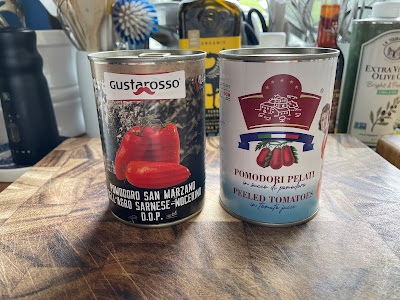
Please try to find canned tomatoes from Italy and Italian pasta cut with bronze dies and slow-dried. The difference is noticeable. The pasta is rough, not smooth, and sauces don't slip off. Excellent online sources for these are BuonItalia and Gustiamo.

I often serve this on a plate with a vegetable instead of a salad. I also recommend opening a particularly delicious bottle of red wine to use in the sauce and drink with dinner.

4 tablespoons butter
About 3 ounces pancetta, cut into ¼-inch cubes
1 small to medium onion, chopped
2 plump garlic cloves, coarsely chopped
1 carrot, peeled and chopped
2 stalks celery, peeled and chopped
4 ounces cremini mushrooms, chopped the same size as the onion, carrot, and celery
1 bay leaf (I use Morton & Bassett—do not leave this out)
½ pound ground beef—preferably slightly coarse
1 (400 g) can Italian whole peeled tomatoes, passed through a food mill
¼ cup red wine (good enough to drink with dinner)
¾ cup stock (I use Better Than Bouillon Vegetable Base)
Freshly grated nutmeg — a little, but do not leave it out
Salt and pepper, to taste
¼ cup heavy cream (or less if you like — be parsimonious)
Freshly grated Parmigiano-Reggiano, to taste

Melt the butter in a wide sauté pan, then cook the pancetta without letting it color — about 3–5 minutes — to render some of the fat. Stir in the onion and garlic, then the carrot and celery, then the mushrooms. Cook over medium heat, stirring often.

Turn up the heat slightly and add the ground beef, breaking it up. Cook for about 3 minutes without stirring so the meat begins to brown, then stir again.

Add the tomatoes, wine, stock, bay leaf, nutmeg, and a little salt and pepper. Let the sauce bubble gently for a few minutes, then reduce the heat until it is just gently moving.

Partially cover the pan and cook for about an hour, stirring occasionally and checking to make sure it doesn’t dry out.

Pour in the heavy cream slowly, using a light hand. Stir and cook for another 15–20 minutes, keeping in mind that you don’t want the sauce to become thick.

Taste and adjust the seasoning.

Cook the pasta, transfer it to the sauce with a little pasta water if needed, and cook together briefly. Serve with freshly grated Parmigiano-Reggiano.

Note

For years I made the classic Bolognese sauce from Marcella Hazan, which I believe is the real thing. This ragù, adapted from The Kitchen Diaries by Nigel Slater, is different — more saucy, with deeper tomato flavor and plenty of umami.


Thursday, February 1, 2024

Hard-Boiled Eggs

Adapted from America’s Test Kitchen Twentieth Anniversary TV Show Cookbook (America’s Test Kitchen, 2019)

Makes 4 to 6 easy-peel eggs

I’ve found this method foolproof. I usually make 4 eggs at a time, but you can make up to 6. There’s no exaggerating how nice it is to have hard-boiled eggs in the refrigerator, ready for snacking, salads, or sandwiches.

These eggs are essentially steamed, not boiled.

Put 1 inch of water in a saucepan and bring it to a boil over high heat. Place a basket steamer in the pan and carefully add the eggs to the steamer. Cover and reduce the heat to medium-low. Cook the eggs for exactly 13 minutes.

While the eggs are cooking, prepare a bowl of ice water with 2 cups of ice cubes and 2 cups of cold water. I keep it in the sink.

When the 13 minutes are up, remove the pan from the heat and use tongs to transfer each egg to the ice water. Let them sit for 15 minutes before peeling.

Depending on the age of the egg, there is usually an air cell at the larger end. I find the easiest way to peel these eggs is to crack the large end, then peel under running cold water.

I was a charter subscriber to Cook’s Illustrated and have been “with them” from the beginning—from Christopher Kimball to where they’ve landed now. Even with all the changes, their mission has stayed on track. They remain an excellent source of inspiration, reliable recipes, and unbiased product reviews.

There’s a group of Cook’s recipes that has stayed in my repertoire since I first found them:

    Shrimp Salad
    The Best Sangria
    Triple-Chocolate Mousse Cake
    Basmati Rice, Pilaf Style

If you’re a digital subscriber to America’s Test Kitchen, as I am, these are all available there. This recipe—along with their method for soft-boiled eggs—is among the most-used in my kitchen.


Caviar and Egg Mold

Adapted from Cook and Love It: A Collection of Favorite Recipes and Entertaining Ideas (The Mothers’ Club of The Lovett School, Atlanta, Georgia). Contributed by Polly Pater and Deedy Bartenfeld.

Serves 6 to 8 as an hors d’oeuvre

4 hard-boiled eggs, mashed
⅓ cup butter, softened
¼ to ⅓ cup mayonnaise (I like Ojai)
⅓ cup chopped scallions or shallots
Lemon juice
Salt to taste
½ cup sour cream (I use full-fat—Fage is my first choice; Breakstone my second)
Caviar, about ¼ cup (or more if you want to be extravagant)

Line a small bowl with plastic wrap.

Combine all the ingredients through salt. Pack the mixture into the bowl, cover with more plastic wrap, and chill well. As the butter chills, it will harden.

Unmold onto a serving plate. Frost with sour cream and top with caviar.

You can serve this with crackers, which makes it easy to put out, but I like it best with buttered white toast points—and that is what I do if the timing works.

There is excellent American caviar now available. I have tried Paddlefish and Hackelback and enjoyed both very much. However, if you can find the lightly salted Spanish grey mullet roe called Mujjol “caviar,” you are in for a treat. It is usually very well priced and delicious, especially if served with sour cream on a salted potato chip accompanied by a shot of very cold vodka or a glass of Champagne. It is worth looking out for and would work well here. Of course, Beluga caviar would work well here—as it would anywhere!—and a little would go a long way.